Tuesday, September 25, 2007

An Evening of Essentials

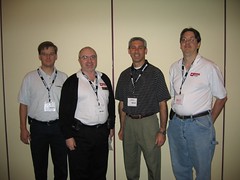
Last night we held the first meeting of the fall for the Waterloo Wellington IT Professionals user group (photos on Flickr). A crowd of about 40-50 attended the event hosted by our local TriOS college in downtown Kitchener, Ontario. Our speaker was Rodney Buike, an IT Pro Advisor with Microsoft Canada. His topic for the evening was Microsoft's System Center Essentials, a system administrator's toolkit in a single package for managing small- to medium-sized IT operations.

Rodney's an experienced presenter and the topic was a timely one, so when you add on a few door prizes, some pop and pizza, and comfortable chairs, you've got the formula for a very good IT evening.

As Rodney pointed out, whether you manage a network of 25 personal computers or one of 2,000 personal computers, the issues of management are pretty much the same. You need a handle on the hardware and software assets, the status of hard drives and services on the servers, the situation with service packs and updates, and notifications and alerts to help you deal with all these issue proactively.

Most of us in small IT shops depend upon a number of point solutions to get the job done. In my own case, asset management is accomplished with the help of an Excel spreadsheet. There is no automatic discovery of assets or of changes in assets, just a spreadsheet with information that may or may not be up to date.

Again, service packs and operating system updates are handled, in my case, by Windows Server Update Services (WSUS), although I still have to manage most of the desktops by hand if users aren't compliant in leaving their notebooks and desktop computers on at night. I also have to do a lot of weekend server upgrades since weekend shift work varies week to week, thereby making a scheduled automatic server upgrade impossible.

Monitoring of essential services is outsourced and seems to work reasonably well, but I would still like all these essential services in a single tool instead of the assembly of point solutions. Rodney's presentation on System Center Essentials gave me a sense of what's possible.

Sunday, August 26, 2007

Hail Mary - Parallelism

iTunes is so cool! Now, in addition to music, podcasts, movies, even PDFs, you can check out university courses and programs, some of which deal with information technology. This morning, I took in the first in a series of lectures from Stanford University entitled, "Computer Architecture is Back: The Berkeley View of Parallel Computing". This specific lecture was given by Dave Patterson in January of this year and is part of what Stanford calls their Computer Systems Colloquium, a series of 14 lectures in "movie" format, available free on iTunes. If you have the 60GB "video" iPod, like me, then you can download these lectures and view them while traveling on the train or plane (uh, forget the car, please, if you're doing the driving!). To get more information, simply head over to SoiT, Stanford on iTunes U at itunes.stanford.edu.


So, what about the lecture and what is the message for computing and information technology in a manufacturing environment?


Patterson's high-level message in this lecture is that everything is changing in computer architecture, that the conventional wisdom of doubling processing speed every 18 months is over, that both hardware and software design need to invest in parallelism, and that a multiplicity of perspectives in the computer industry is required to find solutions for the new predicaments we face. The message for IT in a manufacturing environment (at least a non-computer-related manufacturing environment) is that it looks like the near future will offer far less performance improvement than we might otherwise have hoped for assuming the conventional wisdom.


The metaphor Patterson used is the "Hail Mary", itself a metaphor in football for a desperate play in which the quarterback throws a long pass hoping that somehow somebody on his team will catch it and rescue the team in the end zone. In the computer industry, the same appears to be true. Everyone is betting the farm on parallel computing to solve problems like the power wall we read about daily in the computer press. The "hail Mary" part is that the industry itself doesn't seem to know who or how the pass will be caught. And if the industry doesn't know, how the hell are IT managers supposed to figure this out?


As the computer industry moves uniformly in this new direction, IT guys like me are trying to figure out the implications for designing our systems. Although Patterson tries to make it easier by talking about the "13 dwarfs" - the areas in which multiple disciplines see the future evolving - and the computing world "interest groups" (things like high-performance computing, machine learning, games, embedded systems, and databases) where the 13 dwarfs are mapped, guys like me may feel somewhat overwhelmed.


But I think viewing this material a second and possibly third time brings on the aha experience.


One take home is that programming will have to change dramatically in the next few years. No longer will performance improvements be relegated to hardware. Programmers and developers will have to figure out how to program for parallel processing (Patterson calls this the end of "La-Z-Boy Programming"). Programmers will also have to invest heavily in the psychology of programming, in other words understanding how people interface with computers and making adjustments to make those interfaces more appropriate.


Another take home is that IT managers will have to understand their environment and make changes necessary to find incremental improvements. We can't depend any longer on new servers providing us with huge performance dividends. For example, in a database-driven environment such as ERP systems, IT managers will have to push software vendors in the direction of optimizing database structures, algorithms, reporting tools, querying tools, and integration.


Yet another take home is that knowledge of virtualization will be critical for IT managers, especially as we realize that we need to deconstruct our bloated operating systems, adding only the functions and services necessary to meet a computing objective which is, in turn, linked to a business goal.


Dave Patterson says, "No one is building faster processors." So, given the end of Moore's Law for single-core processing and given the industry's "hail Mary" approach to parallelism, why should IT managers feel optimistic? I mean, after all, are we now relegated to incremental improvements and lobbying with database and ERP vendors?


Patterson admits that the future could be one of failure. But it might also be one in which 1000 cores could be manufactured on a single, economical chip. It might be one in which experts from multiple disciplines work together to design human-centric solutions. It might be one in which the open source programming movement transforms software development by fostering development of minimalist services and functions based on minimalist operating systems and made available to IT managers in a secure virtual package. In other words, there is reason for optimism.


View the lecture for more detail, and check out the innovative Research Accelerator for Multiple Processors (RAMP).

Wednesday, August 15, 2007

Death and Digital Assets

When my brother died in 2002, he left behind some interesting digital assets. They were mainly in the form of artwork he created in his spare time, but also included a personal web site and samples of graphics work he had done for a variety of companies. At the time, his employer's web site design was primarily the result of his creative work.

I now wonder where those assets are. It would be interesting, purely for nostalgic reasons as we get closer to the 5th anniversary of his untimely death, to look again at what he created. But I strongly suspect they have evaporated much like the web site we created as a memorial for him did when the company hosting the site went out of business (it was called wewillmissyou.com; thankfully, I kept backups of the finished memorial web site).


With my recent catastrophic loss of data, as well as my recent medical history, not to mention the approaching anniversary of my brother's death, I've been thinking about digital assets and what happens to them after death. Then today, as I unwrapped my copy of Smart Computing magazine, my eyes were drawn to an article entitled, "Death & Digital Data: What Happens To What You Leave Behind?". The gist of the article is that it's not always clear who owns personal data in an online world. Even the most obvious situations may require litigation to secure assets of a loved one who has died. The case of Lance Corporal Justin Ellworth is an example of an online email company - Yahoo - trying to prohibit the family from retrieving the young man's personal email.


In corporate settings, it's not only the death of an employee that can raise these issues. A simply resignation or layoff can be the occasion for a review of ownership issues, not to mention consideration of what is the humane thing to do. This is especially the case with knowledge workers with corporate notebook computers which act as a repository for both personal and company data. Smart phones, Blackberries, and Pocket PCs are also part of the picture. Even if a company is progressive, for example, and strongly affirms that employees should have the right to retrieve personal data from company assets, if the employee has died, who is responsible for reviewing and separating corporate from personal data, for storing the personal digital assets and getting them into the hands of heirs?


Part of the obvious solution is to backup data, but that can be difficult with online email, web sites, and blog hosts. In my own case, for example, I'm still trying to find and execute reasonable backup utilities to preserve online digital assets like my blog sites and my photo sites (HTTrack WebSite Copier looks promising; Adobe Acrobat Professional also includes a utility for web site downloads).


And then there's online email. What about your hotmail, gmail, Yahoo egroup correspondence, etc.? Not that we'll all be famous after we die, of course, but even the correspondence of the not-so-famous can be extremely useful to historians and cultural analysts, not to mention the families who wish to preserve as much as possible of a deceased loved one's correspondence.


This digital age of ours means not only that we have more assets that will survive us, but that we have to take greater care to preserve those assets for our loved ones.

Friday, August 10, 2007

Gadget Guy, Gadget Guy

So, I have a bit of a reputation as a geek at work. That's not entirely a bad thing, I guess, for an IT Manager. Some of my colleagues poke good-natured fun at me (for the most part) wondering whether there is any more room on my belt for the next gadget to occupy. How will I ever get the flat screen monitor to hang from my belt?

But if there is a refrain that IT managers need to listen to regularly these days it's this - being a geek is OK, but you need to be much more than that. You also need to understand the business and to provide strong leadership. And not just any 'ole leadership will do; it has to spring from a clear understanding of business objectives and a coherent alignment of IT with those objectives.

That's sometimes hard for geeks to grasp. Yes, there will always be a role for a computer technology chief cook and bottle washer, but that's not really what IT management is all about these days. No matter how large or small the company we serve, no matter whether our business context is survival, maintenance, or market breakthrough, no matter how many servers, printers, scanners, pocket PCs, and firewalls we manage, no matter how large the staff - IT managers need to embrace the business and understand the value propositions of their business.

Yes, there are only so many hours in the day. And while it is obvious that you can never have enough knowledge of specific technologies that could benefit your company, it is more important that the technology you do manage be put in service of the goals and vision of the business itself. In other words, technology should always serve business, never the other way around.

If you are like me, the lone-wolf IT person in your organization, then the refrain may be something you know by heart. The real question becomes, "how do I do this?" It's different in every company, of course, and if I had the answer, then it's very likely I wouldn't be blogging about it. All I know for sure is that we need to talk about this, not only with other non-IT colleagues in our organizations, but with our peers and friends in our professional organizations.

For example, in our IT Pro users groups and information processing societies, it probably makes sense to balance the occasions when we show off our technical competence with times of vulnerability when we plead for help in understanding the larger business picture. Sure, iSCSI and SANs and turbo-charged WiFi will get the engines firing on all cylinders in a room full of geeks. But perhaps when we gather together, we need at least 50% of our time talking about how to manage business process re-engineering. What tools and techniques and skill sets do we need to become the business leaders that are needed in IT today? The gadgets can wait...

Wednesday, July 18, 2007

Vista Upgrade - Still at it

Not as smooth as it should have been!

May I complain for a moment? I'm an IT manager, an IT professional. I've been a developer, an early adopter, a geek since 1983. Granted, not all that time has involved a lot of attention to operating system upgrades and deployment. But I'm no slouch either.


So, why the heck did upgrading from Windows XP Pro to Vista Ultimate cause me so many headaches?


Two reasons are stupid mistakes.


  1. When upgrading and using the Windows Files and Setting Transfer wizard, always use the version of the operating system to which you are upgrading (I used the Windows XP Pro version instead).

  2. When doing data backups, especially for a planned upgrade, always use at least two devices (I used one and then dropped the external hard drive; it is now at a hard drive data recovery shop being evaluated).

Yes, even a genius like me can still make stupid mistakes. Just ask my euchre partner.


I should have considered the migration from one operating system to another to be a special case. Members of our Microsoft certifications study group, for instance, mentioned how most of their experiences with FAST have been from one computer to another using the same operating system. But when migrating from one operating system to another, the general rule should be to initiative the transfer using the tools from the newer operating system. My mistake was thinking that I could use the FAST tool from XP. But, again in retrospect, I should probably have used the User State Migration Tool from Windows Vista, instead of the Files and Settings Transfer wizard, even though the MCDST textbook for supporting Windows XP desktops suggests otherwise (70-271, pp.2-21, 2-22 - although the context is always Windows XP Professional only in the instructions).


I thought I had enough backups. About 3 weeks earlier, I can copied My Documents and an archive folder to one external hard drive. Then, as I prepared for a weekend's work of upgrading, I used another external drive with their backup software to take three kinds of backup - a simple file copy, a synchronized folders version, and a typical backup to disk. But as I prepared to go a study group, the external hard drive fell out of my backpack onto the steel stairs behind me. Guess what? Neither I nor two different computer consultants were able to access the drive. Now files that I have used for the past 10 years or more are sitting on a single device at a Toronto-based hard drive data recovery specialist where they are evaluating how much money and time will be involved in retrieving those files.


So you could argue that I'm the author of my own misfortune. You could, but you won't, right?


Still, with the backups that I did have, I ran into problems that required further research, quite a bit of tweaking of both the server on our domain and my notebook's operating system. The biggest problem is roaming profiles with Windows Vista.


Vista has changed - one might even say simplified - the file structure of user profiles. But in doing so, if you use roaming profiles in your domain, you will very likely encounter the dreaded "Your user profile was not loaded correctly. You have been logged on with a temporary profile." error message. When you do a search, you'll inevitably get a lot of misleading suggestions about folder permissions problems on your server or membership problems in the Guests group either on your local machine or the domain. Those discussions won't help you.


Instead, go directly to the Managing Roaming User Data Deployment Guide MS Word document for Windows Vista, download it, and read through the 39-page set of instructions (pick it up here). It took me almost an entire afternoon to implement a portion of the recommendations, but at least I now have my roaming profile working again.


It shouldn't be this hard. I am curious what might have happened had I used the Windows Vista User State Migration tool. Would I still have had the roaming profile problem? Probably, but at least I wouldn't be chewing my nails wondering whether I'll ever have my files back. They would have been transferred to some kind of profile on my upgraded Vista machine. What was a 2-day job has become a 2-week job.


Time for another coffee...wait...wait...


The estimate for the data recovery has just arrived...


Instead of coffee, I think I need a scotch...or two!!!!

Wednesday, July 11, 2007

Technological Regression

An IT manager's life is circumscribed by technology. Most days, he or she takes up a position in the spectrum of technology far closer to the technophiles than the technophobes. Mind you, there are times when the language expressed in the confines of my office definitely turns the air blue.


Yesterday, for example, after having painstakingly created backups for all my work and personal data from my notebook computer for the refresh of my system and upgrade to Windows Vista, I dropped my external hard drive. Today it's not working. My only other backup is incomplete and dates to 20 days earlier. Aaaargh!


Sometimes, the pen and a pad of paper looks very appealing.


But that would be regressive, wouldn't it? And regression is bad, bad, bad...isn't it? Still, I find myself thinking about technological regression and how and why it occurs, because occur it does.


I've just finished reading a massive and highly entertaining novel by Stephen Baxter called Evolution: A Novel. And because I never read one book at a time, I am 3/4's of the way through Guns, Germs, and Steel: The Fate of Human Societies. Neither book is about information technology in the early part of the 21st century. Instead the scope is about global history for the past 13,000 years for the latter, and the entire history of life on earth for the former. In both cases, technological regression not only happens, but is virtually inevitable.


It seems that human populations in isolation (Tasmania since about 10,000 years ago until 1642) not only often fail to develop new technology at all, but often lose what little technology they had. In fact, population densities of several hundred are almost guaranteed to sink back into a pre-technological backwater. Even several thousand is no guarantee that a social unit will grow beyond hunting and gathering.  Environmental factors play a huge role in whether or not societies advance technologically.


Both my novel and non-fiction reading recently have been characterized by themes of technology, evolution, social development, counterfactual history (a kind of what-if analysis), and broad, imaginative rethinking of our place in the universe. And I am humbled. But not just from reading.


My personal life for the past 20 months has been outlined in the shadow of medical technology - a diagnosis of colorectal cancer, followed by MRI's, CT scans, radiation treatment, surgery, post-surgical complications and hospitalization, chemotherapy, and regular follow-ups with oncologists. During that personal struggle, it has been easy to slip into a "why-me?" perspective and a narrowing of concern to the here-and-now. But when I break out of the stupor and think about the the long-term perspective and my place in it, I quickly recognize that the technology I use, the technology that is used for preserving my health, and the technology meant to improve our lives generally is a precarious thing at best. There are no guarantees. And here I'm not thinking simply about disaster recovery or contingency planning. I'm thinking about environmental or man-made catastrophes which undercut the very foundations of our science- and technology-driven society.


Any serious loss of electrical power, for example, and there goes information technology out the window. Sure battery backup will help for a few days, but then your computers, smart phones, and Pocket PCs will be useless. That same loss of power would mean that much of medical technology would be useless, that transportation and production of pharmaceuticals and many food products would cease within a matter of weeks. In fact much of what we take for granted as integral parts of civilization would disappear within as little as one orbit around the sun.


Of course, we can't live our lives in constant fear of societal and technological collapse, but even spending a few hours thinking about the possibilities can be a humbling counterpoint to the hubris we display with all our gadgets and always-on innovations. And occasionally, such reflection might even mean that we choose to forego "best of breed" and "best practices" objectives which are often the result of technological momentum only. Sometimes, with sober second thought, low tech and no tech is the way to go.

Tuesday, June 26, 2007

News Brief - Access 2007 Developer Extensions Now Available

If you've been waiting (and waiting) for Microsoft to provide a way to package and deploy solutions you've developed for Microsoft Access 2007, then the wait is now officially over. According to Eric Rucker, one of the bloggers/developers at Microsoft working on future versions of the perennial developer favorite, the developer extensions and runtime version are available as of 25-Jun-2007.

If you don't need to read about it directly, then here are the links for the downloads:

Access Developer Extensions

Access Runtime

Another resource worth considering is MSMVPS.COM: The Ultimate Destination for Blogs by Current and Former Microsoft Most Valuable Professionals. Tony Toews was the first off the mark to comment on the release (although the problem he reported with one link not working seems already to have been resolved).

A few other bloggers noting this event:

Blake Handler: The Road To Know Where

Clint Covington: Software Design, Microsoft Office Access

Alex Dybenko: Alex & Access

"AccessJunkie" of the MDBMakers.com (A Microsoft Access Developers Help Group)

So, it's time for me to gear up and determine once and for all whether I'll continue to develop in Access 2007. I've been having some doubts...until I downloaded and installed Office 2007, saw the new interface, and picked up my copy of Access 2007 VBA Programmer's Reference. At a wrist-bending 1152 pages, this hefty tome with 4 major Access authors contributing sparked my interest once again. Clearly, the new product offers more than I anticipated, despite some of the fall off among Access MVPs over the past few years.

Expect to see a few more entries on this blog about Access 2007 in the near future.

Sunday, June 17, 2007

EnergizeIT Recap

Yesterday's EnergizeIT event at the Metro Toronto Convention Centre is over, and now the reflection and review begins. It's unusual for IT professionals to commit a Saturday to a vendor-sponsored event like this, but evidently 3,000 other programmers, IT managers, and fellow geeks thought registering for this particular Microsoft event was worthwhile. From our own regional IT professional user group (Waterloo Wellington IT Professional User Group - WWITPRO), there were at least 7 people, although in such a large crowd, there were probably more we didn't see.

Successes

Overall, the event was a spectacular success. The facilities at the MTCC are world-class. The keynote presentations and break-out sessions were all very well organized. In fact, the PowerPoint slide decks are already available online and will soon be followed by streaming video of the keynote presentations (As an aside, the SharePoint site where Microsoft is coordinating all the materials and information about the event is an example of how appropriate technology enriches and extends the experience of a single-day event like this. Thanks to the Toronto SharePoint User Group.)


Innovations

In another first, bloggers could do their reviews of the event in real-time, courtesy of free Wi-Fi connections. Photographers could post photographs immediately to Flickr and tag them with EnergizeIT and see the results on the large screens in breaks between sessions. Very hi-tech, very cool, very appropriate. Kudos to Microsoft and their partners for enabling this kind of connectivity and communications during the event. (Note: some of my photos of the Toronto skyline as viewed from the Holiday Inn on King Street as well as a couple other EnergizeIT photos are here - including one of some of us WWITPRO members with Phil Sorgen, President of Microsoft Canada.)


There were a couple other innovations at the event that merit special comment and congratulations. T-Shirts for geeks (and tiny T-shirts for future geeks) were sold with all the money going directly to a charity. There were attempts to deal with environmental challenges through reducing power consumption (see http://www.bullfrogpower.ca/) and an admittedly symbolic innovation of having evaluations of the event done via online forms. I was also impressed with the wide-screen monitors placed outside each breakout session for those arriving late or who were unsure which session to attend. Great idea!


Cautions

I would recommend more tangible environmental initiatives in the future, including far less vendor paper and brochures in our goody bags. I know that's what sponsors want, but how much of that material gets read before it's tossed in the garbage? I'd far rather a perpetual location like the Sharepoint site with vendor ads than having to carry that stuff around all day.


Hands-on sessions can be a mixed bag. Personally, unless the user has a familiarity already with the broad concepts and layout of the software being demonstrated, there isn't much to be gained from doing a set of exercises. The context is everything. Without that, it's mindless, numbing, and futile.


Thank you's

Thanks to all the TechNet, User Experience, and Developer advisor and product managers for doing this, with special thanks to the support staff who make it all run so smoothly. Thank you to Microsoft Canada for hosting an event like this. You rock, Microsoft! Special thanks to Ruth Morton, the newest IT Pro Advisor for all her help to the WWITPRO executive.


Technorati Tags: ,

Saturday, June 16, 2007

EnergizeIT Underway

EnergizeIT is underway with a flourish and a flurry of T-shirt tossing, high-profile keynote speakers, a great facility, and a breakfast with Phil Sorgen, President of Microsoft Canada. These events are improving each year, with more IT pros attending (over 3,000 this year) than ever.

We have Wi-Fi for onsite blogging, hands-on labs, various streams, vendor exhibits and an atmosphere of excitement and anticipation. As they say, 'get your geek on.'

Technorati Tags:

Friday, June 15, 2007

Being an IT Influencer

Today, I had the incredible opportunity to be involved in an event hosted by Microsoft Canada called the TechNet Connected Summit. It was an invitation-only event in which selected IT professionals from across Canada met with Microsoft Canada IT Pro Advisors, product managers, and technology enthusiasts for a day of non-technical learning, discussion, workshops, and fun.

We learned about initiatives like the Community Connection Framework, Psycho-Geometrics, Microsoft's forthcoming Windows Home Server, technical presentation do's and don'ts, how to win at X-Box 360's Forza, and what product managers actually do for a living. We connected with other user-group executives and IT professionals representing a broad range of interests, levels of expertise, regions, and technology specialties. And all of this in preparation for Saturday's EnergizeIT event.


I'm not sure I feel comfortable with the moniker IT influencer. After all, it seems like just yesterday that I became an IT manager, although it is true that I've been in the computer technology field ever since IBM first released a personal computer in the early 1980s.


One of the alternative names used to describe who we are and what we do today was IT advocate. That makes me slightly more comfortable. It is, in fact, what I tend to do at Microsoft events, at user-group meetings, in my blog and other online activities, and, of course, in my daily work with users and managers at Pano Cap Canada. I seem always to be advocating technology solutions to users, to advocate on behalf of small business to associations and technology vendors, and to advocate use of advanced technology in general in enhancing work and play.


Good things are on the horizon because of events like that hosted by Microsoft today and the relationships being established between IT professionals across Canada. I have a renewed sense of optimism and excitement which will, I'm sure, only be heightened tomorrow when hundreds more of us gather to get our geek on.

Thursday, June 14, 2007

Scoble and Andreessen on Facebook

Blogging got me into this world of social networking and Web 2.0. And it was Robert Scoble and Shel Israel's book, Naked Conversations, that convinced me blogging was a worthwhile endeavor. So, it shouldn't be surprising that those two and other bloggers are influencing me now as I entertain another phenomenon. Facebook has convinced me that we are on the vanguard of something really big, something far larger than blogging.

Facebook is poised, I think, to revolutionize how we use the Internet. One of the reasons I understood this intuitively was by the simplest of measures - how often in a week was I prepared to navigate to Facebook and possibly even update my profile, add an application, visit friends, post messages, or simply browse photo albums and events? Facebook proved its value within a couple days' use. I have been, almost without exception, returning to Facebook every day since I registered.

Then, I happened upon a video of the F8 launch keynote presentation from Mark Zuckerberg, Facebook's founder. Watching that video, I began to realize how quickly Facebook had expanded its audience base to included old guys like me. Within a couple more days, I was reading about Facebook in the local newspaper. Within two weeks, 50 friends had accepted my invitation to join my friends list or had found me and extended the invitation to me. Just today, I began advertising events for our regional IT professional user group meetings on Facebook and extending invitations to IT friends within driving distance.

Other people seem to share my sense of excitement and anticipation. Robert Scoble, for example, pointed yesterday to one of the hottest Facebook applications, iLike, which is reportedly signing up 300,000 people per day. Marc Andreessen, the day before, posted an extensive analysis of the first three weeks since Facebook opened up its platform and APIs to developers.

They both reinforced the lesson that there is a huge difference between an application and a platform, something which ties in with Jared Diamond's insight that the history of technology is often about inventions applied in ways that were never anticipated by their initial inventors.

But the are definitely some gotchas. Andreessen has noticed a few key problems with the applications being developed. One is that success can kill 'ya - unless you have a server farm ready to scale immediately, releasing your killer app for Facebook could mean suicide. He notes some other things too, but take a look at his analysis for details (not to mention his great set of links on everything to do with Facebook).

Sunday, June 10, 2007

Play - The Business Imperative

Facebook right now is more about playing around than anything else. Still, as I continue to read one of the most fascinating and mind-bending books (Guns, Germs, and Steel), I am reminded that the history of technology is replete with examples of inventions looking for an application. Gasoline, airplanes, the internal combustion engine, sticky-notes, the steam engine, the phonograph - they're all inventions whose utility was only discovered well after their initial "invention" and mostly by people other than the inventor himself.

Facebook itself appears to be an innovation whose value and application surpassed that of its founders, much like the World Wide Web itself. But what about business and Facebook? Is social networking of value to business? What parts of the technology can be adapted for use in business?

As of today, I have only discovered 2 other people from Pano Cap Canada on Facebook. That's hardly enough to determine whether Facebook has business utility. But if I were to shift the question slightly and ask about professional utility, the question would seem almost vacuous. Certainly, there is professional utility to a social networking tool that allows individuals and groups to organize and share information quickly and efficiently. The social grid architecture of Facebook means that any shared venture can benefit.

Yes, there are many other collaborative tools out there specifically designed for teams and projects, but the open-ended nature of Facebook and the low cost of participation make it unique, I think. That architecture and openness must mean that there is business utility.

This next week I will be attending a Microsoft event called Energize IT. The sessions will deal with Microsoft technology, but one of the things I'm looking forward to is talking to all the Microsoft and professional contacts I've established through Facebook to address this question about using Facebook for business.

This weekend with Microsoft will be partially about play. I think the big guys are getting the message. Play is critical to developing useful applications. It's critical to building relationships. It's critical to lateral thinking and the application of technology to novel areas, to discovering utility for tools made for other purposes.

Play on!

Tuesday, June 05, 2007

The Facebook Phenomenon

Over 24 million active users on Facebook. More than 100,000 new users joining each day. Growth of 3% per week. Doubling every 6 weeks.

Who are these people? Ages 25 and up are the largest demographic group joining. Ten percent of the population of Canada has already joined. I guess this means Facebook is no longer just a college phenomenon. Soon over 75% will be people out of college.

Over 50% of users return every day. Nobody else in the online community world comes even close. I only started last week, and can attest personally that the experience, although admittedly somewhat impoverished graphically, is incredibly addictive. Facebook has recently passed over eBay and is setting its sights on Google for the most user traffic daily.

The way it intends to do so is with applications, photos being the most obvious. Photo viewing on Facebook has more users than any other photo sharing site on the Internet.

Events are another. As we all know, people share information and interests and tend to go to events based on their friends' recommendations. If I have a relationship with someone, I will be far more likely to attend an event if that person plans on doing so, than if I merely discover that event in the newspaper or on television or some other media.

Applications are key. But what makes the Facebook phenomenon phenomenal is the ease with which connections between friends and friends of friends occurs. Instead of sending an email to a friend or acquaintance about what I'm reading or an event I plan to attend or a copy of a photo of my family, I merely add that information to my Facebook site and immediately all my friends can see.

Even the Status application is something like the stand-alone Twitter social networking tool ... only better. Instead of updating an application, I merely update my status on Facebook and friends around the world know what I'm doing or how I'm feeling. Phenomenal!

It is the recent opening up of the Facebook platform that assures its continued success. That openness is key, as my friend Shel Israel has blogged about recently. Microsoft knows all about how important the developer community is to the success of the whole range of its products, not to mention the mind space devoted to its platforms. So, it shouldn't come as a surprise that Microsoft is partnering with Facebook.

Count in Amazon as well. One the recent applications I've just added to my Facebook site is Books, a place where I can review and recommend books. With this little gem, I can find all the other people in my network who have read the same book, start up a discussion group, or simply chat about the book's contents.

Facebook is changing how I use the Internet. It is certainly changing how I communicate with and relate to my friends and acquaintances.

Monday, June 04, 2007

ITIL for grown ups?

Today's the big day, I guess. The Information Technology Infrastructure Library v3.0 is released today. SearchCIO sent a story to me today explaining how v3 is ITIL for grown ups, possibly because the emphasis of this "best practices" guide for IT services is targeting CIOs.

V2, first released seven years ago, has been replaced by V3, a move from just tactical improvements to strategic improvements. If the hype has legs, then the shift is towards understanding how IT adds value to business objectives and not just organizing the activities IT managers do and manage each day.

Companies like HP are investing heavily in v3, hoping that middle level companies will invest not only in the published guidelines but in consulting services to implement those high-level recommendations.

I'm still left curious as to how ITIL factors into the development and growth of small IT operations such as the one I manage for Pano Cap Canada. Whether it's v2 or v3, how exactly do one- or two-person operations learn from ITIL and improve their operations and strategic alignment with business?

Saturday, June 02, 2007

The Mystery of 'Milan' - Microsoft Surface

One of my favorite vacation hot spots is Las Vegas. By the end of the year, I expect to find "surface computing" devices floating about in the casinos using Microsoft's 'Milan', essentially a hardware/software combo running Vista and getting input directly by touch from one or several users at a time. Obviously, gaming in the Wynn or the Bellagio or Caesar's Palace with a few friends or drinking buddies gathered around a surface computing table will have a definite cache.

By the way, the screen for Milan is not a touch-screen, typically understood and used today. Instead, the surface is hard, large and "interactive" both in the sense that you can manipulate objects and put Wi-Fi objects like cameras on the surface and immediately download the photographs without doing anything else.

Commercial applications offer tremendous possibilities. T-Mobile applications have already been written that would let a sales associate and a potential customer place phones on the surface and immediately get detailed information on each, adding service configurations, ring tones, etc by moving objects around on the 30" diagonal surface.


Educational potential is amazing. Imagine devices like this in a cancer center where patients are waiting for radiation or chemotherapy and would like to interact with a counselor, a dietician, a nurse, or an oncologist explaining not only treatment plans, but options, diagrams and animations of the process to the patient (check out the University of Calgary's CAVEman virtual human for an example). Or imagine students designing a school newsletter interactively with their photos, articles, banners, etc. all available for joint manipulation. The possibilities of social interaction and training are truly staggering.

Milan isn't mysterious to the imagination. We've "seen" it before in movies like Minority Report. It isn't mysterious that it took a company like Microsoft to pull the ingredients together (things like 5 infrared cameras set below the display top to detect objects like cameras, Zunes, etc; and a custom DLP - digital light processing - engine, not to mention an operating system like Vista that is up to the graphical and input/output demands). What's mysterious to me is why the possibilities of this kind of computing experience isn't seen for what it is; namely, a revolution as significant as the move from text-based to graphics-based computing.


Update
Talk about synchrony! My colleague and friend, Ruth, an IT Pro Advisor, wrote this morning about Microsoft's surface computing at her personal blog. Check it out. Her embedded Popular Mechanics video gives a great illustration of the ease of use and multi-point input technology behind "Milan".

Saturday, May 12, 2007

Dell Watching

We use a lot of Dell products at Pano Cap. We've standardized on PowerEdge rack servers in the data centre and Latitude and Inspiron notebooks for those needing mobility.

Over the years, I've been pleased with the durability, reliability, and performance of our computer systems. The servers, especially, have performed well and needed little in the way of replacement drives or power supplies.

The notebook and desktop computers (again, most of which are Dell products) have not been as stellar performers as our servers, but they still provide good value and have been relatively maintenance free. It's true that we have sometimes been irritated and frustrated with the purchasing process, but now that we entrust most of our hardware purchases to a single supplier, the aggravation of dealing directly with different arms of Dell financial services has disappeared. So too have maintenance issues by simply assigning all of that to our supplier.

But things have not gone well for Dell in the recent past. Their customer service reputation has taken a beating, especially among bloggers quite willing to point out the deficiencies of technical support. Market share has been slipping, with both HP and Acer making inroads. Hewlett Packard has the largest share of the market, Dell second, with Acer and Lenovo in a virtual tie for third place. In the United States, Apple has grown faster than any other PC maker.

So it may not be too surprising to see Dell making changes. As of 31-Jan-2007, Michael Dell resumed the CEO role; on 24-April-2007, Dell began offering solid state drives in the Latitude D420 and D620 notebooks; on 27-April-2007, a leaked memo from CEO Michael Dell suggested that the long-time direct selling mantra of Dell might be augmented by channel sales ("The Direct Model has been a revolution, but is not a religion"); and finally, on 1-May-2007, Dell announced that Canonical had been chosen as its partner to provide some desktops and notebooks pre-loaded with Ubuntu ("Linux for Human Beings").

Whether these moves will have any direct impact on us directly or not remains to be seen, although one suggestion of offering customers an option of either Vista or Windows XP would be welcome (a recent purchase of a notebook was only available in Vista); an even better option would be a dual-boot option with both Windows XP Pro and Windows Vista.

Tuesday, April 24, 2007

Unify Tour 2007: Building, Deploying and Maintaining the Application

Ruth Morton is a friend, not just a colleague in IT. She asked that I provide her with some constructive feedback on her presentation to the Toronto-and-area IT professionals and developers attending the Unify Tour 2007. But being a friend doesn't mean that I won't be as objective as possible.

Having said that, I have to say that what I'm seeing in the Windows Live Meeting webcast for this second session of the day is impressive. For the first time since I've been attending these sessions from Microsoft, not only is there interaction between IT pros and dev types in the presentation itself, but the additional implied friction and humour adds the ring of truth as well as comic relief in what otherwise is often a "talking heads" experience. Ruth's colleague, Christian Beauclair, is especially good at juicing it up in the interaction segments between the developers and IT professionals.

Microsoft's new System Center Operations Manager 2007 appears to be a powerful new tool in the arsenal available to IT professionals for monitoring application performance. Of course, PerfMon still provides some value.

Ruth is quickly developing facility with presentations like this. I'm glad to see Microsoft branching out slightly by adding the female voice to the IT Pro community. And I will certainly recommend presentations like this continue to use interaction, implied role friction, and humour. Good show!

Unify Tour 2007: Better than being there

I'm currently watching Session 1: Designing Architecture from the last stop of Microsoft Canada's Unify Tour 2007. The tour is all about how professional developers and IT professionals can collaborate together on the entire product lifecycle from design to deployment to monitoring and management.

Although I couldn't be at the in-person event today, I am watching it using Windows Live Meeting. While I don't get to mingle with IT Pro Advisors and colleagues in the industry, the streaming webcast is in some significant ways better than being there. I'm not talking simply about avoiding 3-4 hours of commuting to Toronto from Kitchener and back again, or even about the luxury of having my notebook computer for notetaking, maximizing and minimizing screen shots, or even blogging while sessions are being delivered. No, I'm talking about really important things, like washroom breaks, fresh home-made coffee, and leaving my cell phone on full volume.

Yeah, it's also useful to have access to the Internet, chat features with other remote session viewers and Microsoft IT Pro Advisors. But can that really compare with watching the sessions in a recliner?

Having spent many years in development and coding, this 10,000-foot overview of some of the new tools for design were quite impressive. The new Visual Studio Team System includes some features which really impress, including the new DB Pro role, auto-generation of sample data in the developer's SQL Server Express prototype database, specific service pack and other IT-related settings for design components, and source control for database schemas.

Kudos to the MSDN and TechNet presenters, Christian Beauclair and Damir Bersenic.

Wednesday, April 18, 2007

Virginia Tech and Wireless Access

A recent news article from eWeek.com indicates the there were wireless access problems at Virginia Tech on Monday. As you might expect, there were massive increases in the number of wireless voice calls and text messaging during the crisis, especially between 9:00 am and 2:00 pm. Verizon acknowledged some calls were blocked, but most text messages went through. Cingular claims no calls were blocked. Sprint Nextel also claimed no service interruptions despite the increased volume.

I hope most corporations never experience a crisis like that of Virginia Tech on Monday. But it is a virtual truism to suggest that wireless access is quickly becoming indispensable to modern business processes. From WiFi phones to hand-held computers and scanners, from Pocket PCs to notebook computers carried to various meetings, the advantages of information at your fingertips and communications technology available anytime hardly need justification anymore.

The Virginia Tech crisis only highlights a growing realization among IT professionals. Most IT managers are beginning to reflect on how inexpensive devices might be used in corporations to improve everything from disaster responsiveness to on-the-spot job training to line-of-business information retrieval. Given the eagerness of telecommunications companies to sell smart phones in quantities to companies, you can readily imagine a situation where everyone in a company from the President to janitorial staff would be issued a joint cellular/WiFi phone. The WiFi costs would be covered by the company, while most cellular usage would be the responsibility of the user (if used at all).

When an employee comes to work, they use the device to send and receive instant messages or text messages, to read and write corporate email, to gain instant access to operating procedures and policies, training manuals and even for information access to ERP applications as required. Devices would be subject to policies preventing misuse, of course, but some kind of automated monitoring service which aggregates usage statistics would help managers determine who is doing what when and then take appropriate disciplinary measures if necessary.

I don't think this is too far fetched. After all, many families are already there with every member having his/her own cellular phone and/or computer. High tech companies are already using either blackberries or smart phones with almost 100% distribution among employees. Soon enough, the manufacturing and other industrial sectors will see the same advantages. After all, not everyone in a manufacturing company can have access to a computer. But if we could reduce costs to, say, $200 per user per annum, wouldn't the advantages be obvious?

Wednesday, April 04, 2007

Predicting IT Trends - Microsoft Databases

My family and I like to visit large bookstores together. We tend to drift apart shortly after arriving only to come together again for coffee and treats in Starbucks. I tend to head over to the science and technology section and the computer-related bookshelves, my wife to the novels, my eldest son to the gamers area, and my youngest son to the culture studies section.

One thing I like to do while perusing the computer books is to predict trends in information technology. What programming languages are getting a lot of coverage? What certifications are taking off? What popular trends are emerging in web services? What databases get the most press?

This week, I had fully intended to attend a regional Microsoft event entitled The Exciting Adventures of the Microsoft Application Platform Developer not just because it was intended for both developers and IT managers, but because I was curious about what trends were emerging in Microsoft products for data-driven applications and web sites. Unfortunately, I felt too ill to attend the event. But it still got me thinking and wondering about the future.

Why is it, for instance, that I see so little on the bookshelves about a product like SQL Server Express? I bought Rick Dobson's Beginning SQL Server 2005 Express: Database Applications with Visual Basic Express and Visual Web Developer Express, From Novice to Professional some time ago, believing that I should become conversant with a product that seemed ready to infiltrate small to medium-sized businesses who had outgrown Microsoft Access. But I haven't seen it on the shelves recently, nor any of the many SQL Server Express books available online. Based on the books lining the shelves in Chapters, I'd have to say there isn't much of a future in store for SQL Server Express.

But maybe it's just a matter of timing. Maybe it's a matter of my being interested primarily in small and medium-sized businesses. Maybe Microsoft needs to do a little more marketing. Or...just maybe Microsoft Access still can fulfill most of the requirements for departmental databases, for small- and medium-sized databases without worries about the .NET CLR, XML data types, etc. Certainly the Chapters bookshelves look more promising for Access than SQL Server Express.